

You may have eaten from it in a school canteen, a restaurant, a hotel or while on holiday. You may have held it in your hand dozens of times without having the faintest idea who designed it. The ‘Praha’ porcelain range is celebrating fifty years of continuous production this year, and its story is also the story of Czech design, the hotel industry and gastronomy. Over the past half-century, Karlovy Vary-based G. Benedikt has produced approximately 70 million pieces from this range, and today it builds on the legacy of this iconic design with collections that explore new forms of professional dining.
Some objects become such a natural part of everyday life that we cease to notice their origins. The ‘Praha’ porcelain set is precisely such an object. Its distinctive shape has featured in professional catering for fifty years and, during this time, has become one of the best-known examples of Czech design that has successfully combined aesthetics with the demands of day-to-day use. The set was created by designer Jaroslav Ježek, who developed the design for production in 1976. Since then, some 70 million pieces of this set—manufactured by G. Benedikt in Karlovy Vary—have passed through the hands of guests in restaurants, hotels and canteens. The company itself builds on a tradition dating back to 1882, when the Benedikt brothers founded a porcelain factory in Dvory.
The ‘Praha’ design was created at a time when the professional catering industry was undergoing rapid change and needed tableware that would not only look good but also withstand the rigours of daily, intensive use. Ježek designed a complete range, from plates to teapots and cups, and the set gained popularity partly thanks to its practical stackability. The ‘Praha’ name was taken from the hotel of the same name in Prague’s Hanspaulka district, which was built between 1975 and 1981. As early as the year of its launch, it represented Czechoslovak production at the International Exhibition of Glass and Porcelain in Jablonec nad Nisou. The design thus gradually became an everyday object and one of the most distinctive hotel designs of its time.
From an iconic shape to contemporary design
The 50th anniversary of ‘Praha’ is not merely a nostalgic look back. It is also a reminder of how professional porcelain has transformed over the last decade and of the role that design plays in gastronomy. Today, G. Benedikt produces more than 40 porcelain designs and, together with designers, is gradually developing new approaches to relief, colour, finishes and the form of tableware itself. The ‘Praha’ collection has since been followed by, for example, the embossed Melodie, the colourful Lifestyle, the solid-coloured Granit, the organically shaped Flamenco, and the latest Stone collection, which plays on the contrast between matt and glossy finishes.
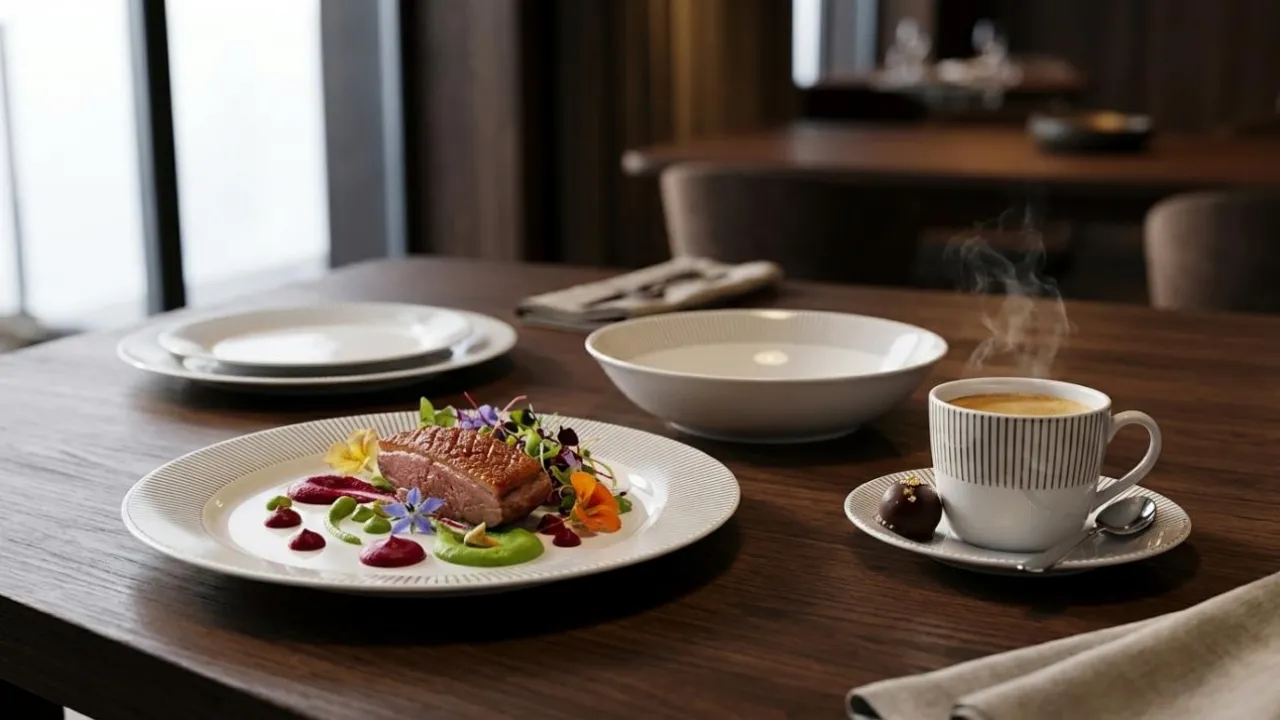
This is where the story of G. Benedikt becomes particularly interesting from the perspective of contemporary gastronomy. Porcelain is not merely a neutral backdrop for food. Shape, proportions, colour and surface all influence the way a chef presents a dish and how a guest perceives it. Moreover, professional tableware must withstand conditions that a design object for domestic use does not usually have to cope with: hundreds of dishwasher cycles, knocks, thermal shocks, daily handling and demanding storage conditions. G. Benedikt therefore emphasises not only aesthetic qualities but also durability, practicality and space-saving storage across its collections. According to the manufacturer, its porcelain is resistant to impacts, thermal shocks and cleaning agents, and the individual sets are designed with the real-world needs of professional kitchens in mind.
At the same time, the possibilities for personalisation are evolving. Alongside mass production, G. Benedikt also offers bespoke modifications, including custom designs and printing. This combination of traditional production with the ability to create individual solutions demonstrates that professional porcelain today need not be merely a standardised part of the inventory. It can become part of the identity of a specific hotel, restaurant or dining concept.
Fifty years of the ‘Praha’ shape, over 140 years of porcelain tradition
The anniversary of the ‘Praha’ design is thus just one chapter in a much longer story. Today, G. Benedikt, together with the Austrian brand Lilien Austria and the Swiss brand Suisse Langenthal, forms the G. Benedikt Group, which builds on a shared tradition, experience and an emphasis on durable professional porcelain. According to the latest figures, the Karlovy Vary-based manufacturer exports to 48 countries and, in addition to more than forty porcelain designs, also offers other solutions for the professional catering sector.
It is telling, however, that one of the company’s most successful products remains a design that is half a century old. The ‘Praha’ soup bowl, with a capacity of 46 centilitres, still sells in the Czech Republic at a rate of approximately 160,000 pieces a year. This figure clearly demonstrates how deeply this design has become ingrained in the Czech catering sector. At the same time, however, G. Benedikt does not wish merely to preserve its history. “For us, tradition does not mean repeating the past. It means building on the best of what came before us and seeking new solutions for contemporary gastronomy,” says Pavel Janák, CEO of the G. Benedikt Group.
The fiftieth anniversary is also being marked by a limited edition in the ‘Praha’ shape, featuring the ‘City of a Hundred Spires Made of Spines’ design, created by graphic designer Marika Machková. In this design, the silhouette of Prague is composed of hedgehog spines: the towers are formed from bundles of needles and the dome from rays. It is a contemporary interpretation of a design which, in its own right, has managed to survive several generations without losing its place in professional gastronomy.
Perhaps this is where the most interesting part of the G. Benedikt story lies—not in the fact that a single porcelain shape has lasted fifty years, but in the fact that it has become part of everyday life without losing its function. And while ‘Praha’ remains a testament to Czech design of the 1970s, new collections demonstrate that porcelain can still be an active instrument in the gastronomic experience today. Thus, Karlovy Vary produces not only tableware for restaurants and hotels, but also a piece of Czech design that, for more than a century, has sought to combine craftsmanship, industrial production and the needs of people who set the table for their guests every day.