How did the top Prague establishment prepare for the inspectors of the prestigious guide, and what did the brand-new spring tasting menu reveal?
Chef and co-owner Radek Kašpárek told VisitChef in an interview in November that he wanted a second star for his restaurant, Field. The ambition is right on target; it's neither exaggerated nor pompous. Why?
There are several chefs in the Czech Republic who rightly wish for a Michelin award for their establishments. Some have said it out loud, while others believe in it and work without comment. In the case of Field, as one of only two Czech restaurants to boast a star thanks to the latest edition of the Michelin Guide so far, it makes sense that Field and the chef there would want to move on. And further, in this case, means a second star. We can't see into the minds of the Michelin commissioners, who have most likely started visiting Czech restaurants these weeks, but if two stars for a restaurant were to make a mark on the local gastronomic scene, Field should be one of the two establishments in the country that deserve a "two." That's where the text could end. But let's take a look at why Field is further ahead than most places in the country. The new tasting menu that was introduced these days will help us very well.
Already in its first years of operation, Radek Kašpárek's restaurant set the bar in service, among other things. A comprehensive and unforced presentation of individual dishes simply belongs in a fine dining environment. In vain will some complain that the presentation of individual courses is too long or detailed. Sure, the server is supposed to sense the mood of the table and add or subtract accordingly; on the other hand, quality service and a well-done familiarity with the food on the plate are part of the puzzle that defines experiential dining.
After the initial service of bread and butter, from which the fragrant roasted venison emerges most interestingly and safely, comes the first amuse-bouche, through which guests find their own truffle. It's homemade, and the service doesn't give away the recipe at first, only telling you that you need to reach into a pile of leaves and fish out the truffle. You can even go for the smell, as a few drops of truffle oil will do the job perfectly, as will the combination of truffle with Vichyssoise cream. Of course, this is a tasting portion, so it's no problem to sip this soup with the included straw. The second amuse-bouche doesn't fall short of the first in terms of imagination, as the local kitchen combines horseradish mayonnaise, fermented gooseberry, rhubarb goulash, and smoked mackerel in a sandwich of two parsley wafers. Taste-wise, however, the last of the kitchen's greetings is the freshest: a fried calf's head croquette with tarragon mayonnaise at the bottom, the black garlic gel covered by slices of kohlrabi on the croquette.
An interesting surprise is the starter of pickled lamb with fish emulsion, red grapefruit granita, and mountain trout caviar, which finishes the service first with a citrus sauce and then a few drops of ginger oil. The red grapefruit and citrus sauce might be reproached by some colleagues, but other chefs would agree with the idea of not limiting themselves. When asked, Radek Kašpárek himself replies that Field is European cuisine, and citrus simply belongs there.
Of the twelve courses that make up Field's long tasting (if we don't count the bread and butter), let's describe a dish of grilled rabbit belly combined with roasted mushrooms (shiitake), accompanied on the plate by foie gras and young herbs. What's interesting about it, though, is the service. It stands out above the rest with its work. The server, at the table in front of the guests, crushes a piece of dried mushroom, then mixes the dust with citrus oil and adds buckwheat tamari at the end. Only then does he begin to drizzle the dish with the exquisite final umami mixture. This process and preparation before the guest is one of the main elements of the progression Field has made over the last while. And if you're asking if it's a two-star dish, it is. Overall, the great presentation that Field is known for takes on a new, more interesting, and even better dimension.
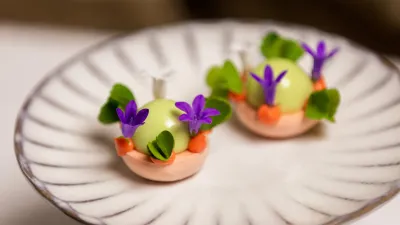
Before the desserts come out, lamb and veal appear on the plate after the rabbit belly. Both meat combinations are perfectly executed, as well as plating throughout the evening. The simple yet beautiful presentation (even in the case of the main meat courses, which is always directed towards the center of the plate) has always been taken care of at Field, and the same is true of the current menu, which already represents spring 2024. Field not only remains one of the top restaurants but also one of the driving forces of the Czech gastroscene. It inspires establishments across the country with its various elements and is undoubtedly one of the few places that set trends, as well as one of those restaurants that can be compared to like-minded foreign cuisines.