
We returned to Zlatá Praha to sample the current version of Maroš Jambor’s classic tasting menu. The autumn menu centres on fish, game, local produce, and flavourful sauces. Wine pairings also play an important role, taking guests on a journey from the Moselle through Burgundy and Spain to Moravia and Tuscany.
Dinner at Zlatá Praha doesn’t begin with a grand gesture, but with a few small bites that gradually prepare the palate for what’s to come. The table is graced with a delightful consommé of roasted leek and root vegetables, superb smoked eel with black garlic, carrot tartare with rosemary, and gougères filled with sheep’s cheese. It is already clear here that Maroš Jambor does not wish to dictate how guests should experience the meal. The canapés can be sampled in any order, depending on whether you already have an aperitif on the table or are starting with a glass of water. Everything has its own rhythm, but there are no strict instructions. You can choose your champagne by the glass; we opt for Krug Édition 174.
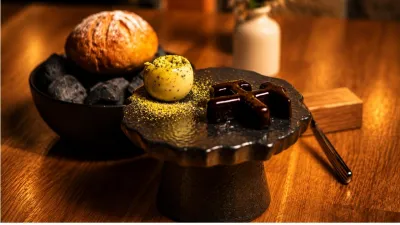
This is followed by Imperial caviar with just three per cent salt, a quail’s egg, and Prague ham. Krug Édition 174 pairs perfectly with this dish; its complexity and fine effervescence add another dimension to the caviar’s delicate saltiness. The dish is also served with homemade bread, of which the Zlatá Praha team is clearly very proud. The Šumava rye bread with caraway and potatoes undergoes a 24-hour fermentation; alongside it sits milk bread with thyme, fried onion, and poppy seeds. There’s also lightly salted cultured butter. Here, bread isn’t just an accompaniment, but a fully fledged part of the dining experience—and you can ask for more at any time.
It’s all about the sauces, the tang, and the right finishing touches
The cold starter consists of marinated pikeperch with dill, vine leaves, and a mint sauce. It is a clean, fresh dish that allows the fish to shine while making the most of the herbal aromas. It is accompanied by a 2024 Riesling ‘Vom blauen Schiefer’ from the Clemens Busch winery on the Moselle. From vineyards with blue slate, it offers a more citrusy, elegant, mineral character. It brings purity, lively acidity, and pleasant minerality to the delicate fish and fresh herbal notes.
Next comes the cauliflower royale—a delicate savoury pudding—served with kotrč, cauliflower sauce, trout roe, marjoram oil, and smoked paprika. It is here that we see just how important a role sauce plays in Jambor’s cuisine. It is not merely an accompaniment, but one of the main components of the final flavour. Its creamy character is complemented by the Aligoté Hors Classe 2024 from the Burgundian Domaine Buisson-Charles. The wine spent eighteen months in wooden barrels on fine lees, giving it body and a subtle hint of wood. At the same time, it retains a distinct, fresh acidity that pleasantly balances the creaminess of the dish.
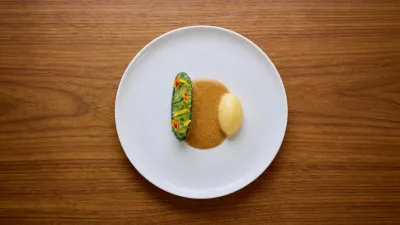
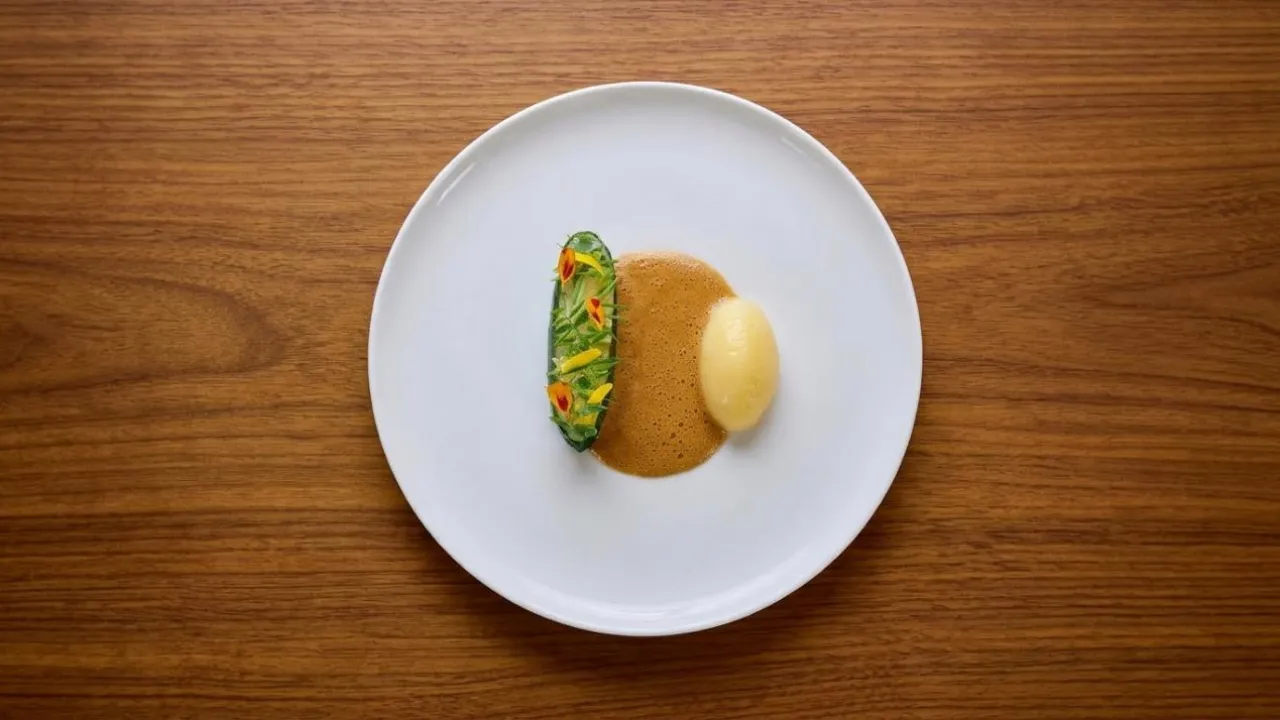
The next course features confit sturgeon from the renowned Chabrybárna. The fish is wrapped in Swiss chard, with a stuffing and a rich crayfish bisque hidden inside, complemented by an Annabelle potato confit in garlic oil. It is precisely this intense crayfish sauce that calls for a red wine (yes, even now, at the start of the tasting) that will not overpower it. The choice falls on the 2024 Comando G ‘Navatalgordo’ Sierra de Gredos from the Navatalgordo vineyard in the Spanish region of Sierra de Gredos. Old vines growing at an altitude of around a thousand metres give the wine its structure, while the mountain conditions help it retain its freshness. The result is a lighter, elegant red with a hint of cherry, which the sommelier compares in character to a Burgundian Pinot Noir. It’s an interesting choice to accompany fish—and an example of how pairing doesn’t automatically mean white wine with fish.
And then comes the famous duck. In our case, it wasn’t part of the regular menu, but Jambor’s signature dish, which we were treated to as an extra. The duck is marinated for fourteen days in honey and then roasted whole on a spit. The plate features sliced breast with red cabbage, autumn plums or damsons, and a rich sauce made from duck bones underneath. It is a hearty, top-class, highly distinctive dish that relies not on showy presentation, but on high-quality ingredients, time, and a well-structured flavour. The honey in the meat and sauce is nicely balanced by the juicy fruit and red cabbage. The duck is paired with Roučí 2024 by Jaroslav Špringr, a Moravian Pinot Noir that has been aged for sixteen months in oak barrels from the Burgundian cooperage François Frères. The wine is juicy and elegant and, according to the sommelier, has a slightly higher extract than previous vintages. Moreover, its slightly sweet tannins on the finish complement the honeyed notes of the duck beautifully. Here, the two parts of the evening come together convincingly.
Czech fallow deer, Moravian wines, and a sweet finale
After the duck, it’s the fallow deer’s turn. The saddle and sausage—a signature element of Jambor’s cuisine—are complemented by celery, pine cones, and an elderflower Pontack. The venison naturally ties in with the autumnal character of the dinner and offers further scope for more pronounced flavours. The meat is served with a red wine from the 2021 vintage by Nepraš & Co, in which Frankovka plays the leading role, complemented by Cabernet. Winemaker Ondřej Veselý builds on the previous vintage here, but alters the blend in favour of Frankovka. The wine is produced through spontaneous fermentation, maturing for the first year in a large oak cask and the second in a barrique. It is bottled unfiltered. The sommelier himself admits that it still needs a little more time, but it pairs very well with fallow deer. Moreover, Czech wine with Czech game is a pairing that makes sense not only in terms of flavour.
Next comes one of the best dishes of the entire evening: Heřmanice Camembert made from the milk of Jersey cows, topped with grated white truffle. Beneath it lies honey made from spruce shoots and grapes, while on the side there is apple balsamic vinegar and malt bread with dried fruit. Perfect, extremely interesting, and yet still unpretentious. This part of the evening also features a 2015 Brunello di Montalcino from the Tuscan winery Ridolfi. The wine comes from higher-altitude vineyards east of Montalcino; it is aged in traditional large oak barrels and, thanks to extended maceration, has a pronounced structure but no aggressive tannins. Its more elegant style and freshness provide an extremely interesting contrast to the fuller flavours at the end of the savoury part of the menu.
The sweet section of the menu begins with hand-harvested grapes from the Fabig winery—specifically the Sauvignon Blanc variety—served with a must sorbet and a tarragon sauce. The freshness and light herbal notes—this time bearing the signature of head pastry chef Romanka Zelinová—set the scene for the blueberry dessert. This is served with an ice wine from the Nigl winery in Kremstal, Austria, made from the Grüner Veltliner grape. Its natural acidity balances the residual sugar and complements the dessert’s delicious, fruity character perfectly.
The blueberry dessert itself combines cultivated and wild blueberries, sumac sponge, kefir cream, hyssop caramel, and whey-based kefir ice cream. The evening concludes with petit fours: an exquisite apple tart with spiced caramel, mirabelle plum and chamomile sweets, and Becherovka jelly coated in lemon balm sugar.
Zlatá Praha, under the leadership of head chef Maroš Jambor, offers cuisine that does not seek to impress guests at any cost. Instead, it focuses on a carefully considered sequence of flavours, high-quality ingredients, and artisanal details that fit together naturally. The drinks menu plays an equally important role in the evening. Wine pairing is not merely an accompaniment to individual courses, but another way of interpreting, complementing, and at times surprisingly enhancing their flavours.