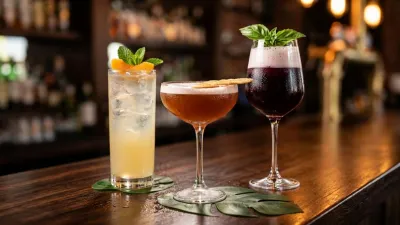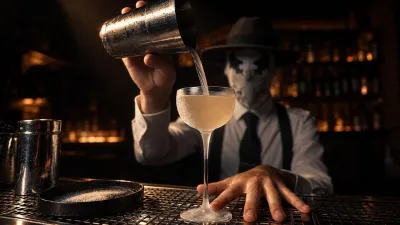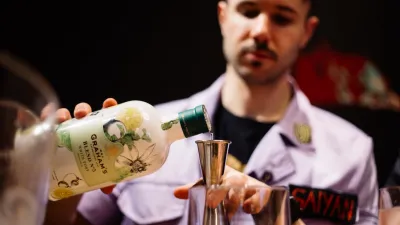

From an elegant Chocolate Martini to a cocktail inspired by Chekhov’s Three Sisters, and even a pairing with a meat platter, elite premium vodka proves its place isn’t limited to classic cocktails or a shot on the rocks. We visited three distinctive Prague establishments to find out how local professionals work with it — and each of them approaches it in a completely different way.
Vodka occupies a somewhat peculiar position in the world of gastronomy. It is often spoken of as a neutral spirit, whose main purpose is to provide the alcoholic base for a cocktail without interfering too much with the final flavour. With truly high-quality bottles, however, such a perception is somewhat simplistic. It depends on the raw materials, the production method, filtration, texture and the character of the spirit itself. And it is precisely these qualities that form the basis of Stoli’s elite, ultra-premium vodka, which was launched in 2003.
Its production is based on a carefully selected, single-source grain spirit and water from artesian wells. This is followed by multi-stage filtration through quartz sand and birch charcoal, culminating in a process known as freeze filtration. During this process, the vodka is cooled to exactly −18 °C and then passes very slowly through special ion-charged filters. This process, inspired by the ancient tradition of storing spirits in freezing winter conditions, is designed to remove even the finest impurities and preserve the vodka’s exceptional purity, smoothness and silky texture. Production and bottling take place in Riga, Latvia, at the historic Latvijas Balzams distillery. The quality of the product is also attested to by a platinum rating of 97 points from the Beverage Testing Institute, where this elite vodka consistently ranks among the highest-rated vodkas.
It is precisely this purity and smoothness that make it an intriguing ingredient for the contemporary bar scene. This does not, however, mean that it should remain invisible in every drink. On the contrary: in the right hands, it can form a solid foundation on which other ingredients can shine, while also giving the cocktail the necessary structure.
Hemingway Bar: Bon Vivant – a tribute to life without compromise
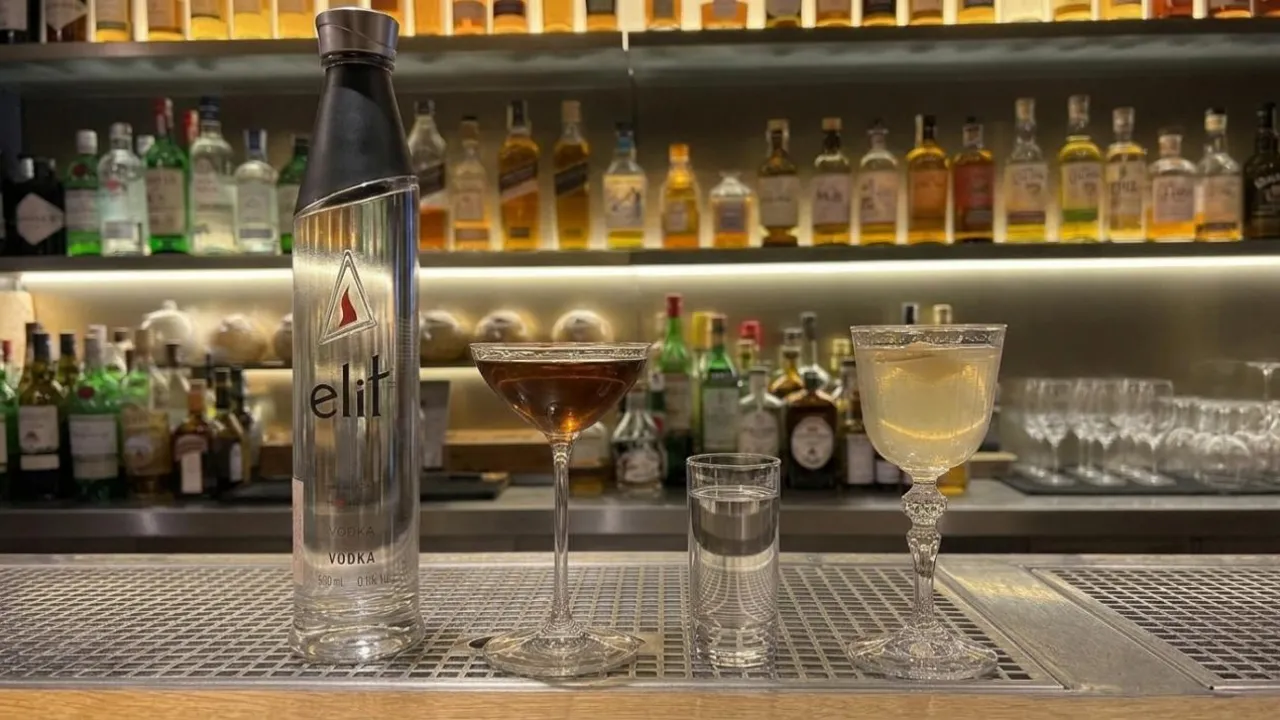
Our first stop was Prague’s legendary Hemingway Bar, where head bartender Miki Pitonak introduced us to the Bon Vivant cocktail. The name itself suggests inspiration from Ernest Hemingway and his love of the good life, fine drinks and everything one enjoys with relish. The drink is built around premium Elit vodka and combines ingredients that were historically considered luxurious and out of reach for most people — coffee and chocolate. The result is an elegant variation on the Martini with a distinctive coffee-and-chocolate profile, which does not veer into excessive sweetness.
“It’s a sort of Chocolate Martini, but at the same time the drink has a certain sharpness. The resulting flavour profile is slightly sweet, with notes of coffee and chocolate,” describes Miki Pitonak.
The cocktail was created by David Andrle, who developed his original concept for a Martini into a more sophisticated composition. Sandalwood tincture also plays an important role here: it brings a woody, dry quality that balances the sweeter ingredients and adds another dimension to the drink. The presentation is just as carefully thought out as the recipe itself. The cocktail is served without ice in a thoroughly chilled coupe glass, and its sole garnish is a coffee bean coated in gold dust — an edible detail that emphasises the character of the entire drink. Bon Vivant is thus not merely a showy sweet cocktail, but above all an elegant and relatively complex interpretation of luxury, in which Elit has its natural place.
Forbina: Chekhov, beetroot and carrot in a single glass
A completely different approach has been taken at Forbina, a progressive Prague bar that isn’t afraid to experiment with ingredients or bar techniques. Here, bartender Pája Nguyen has created the ‘Three Sisters’ cocktail. The name refers to Anton Pavlovich Chekhov’s famous play, but also to its Russian setting and the main characters’ longing for a fulfilling life in Moscow. In this case, vodka is a natural reference to Russian cultural tradition, beetroot to local cuisine, and carrot symbolises the theatrical motif of longing and the striving to achieve a desired goal. Spruce wine also features in the story, evoking nature and the rural setting through which the departing army passes at the end of the play.
‘Three Sisters’ is a twist on the Martini — specifically in the form of a so-called Frozen Martini. Alongside premium vodka, it contains spruce wine, beetroot, Apollo beetroot spirit and fresh carrot juice. It is precisely this last ingredient that is key to the preparation technique. Carrots contain fibre and pectin, which the bartender utilises during the subsequent ageing and filtration process. The result is a clear drink that retains the subtle flavour of the carrot and its natural dilution. “We combine both water dilution and carrot dilution with the very distinctive flavour of Apollo,” explains Pája Nguyen.
Developing the recipe, however, wasn’t a matter of a single afternoon. It was necessary to find a balance between the individual ingredients, their intensity and the resulting texture. Working with plant-based ingredients is also interesting: the bartender points out that a similar principle can be applied not only to carrots, but also to tomatoes, pineapple, courgettes or celery. The resulting cocktail has a slightly earthy, floral and nutty character, with a delicately sweet finish. No frills, no unnecessary gimmicks. ‘Three Sisters’ demonstrates just how far one can take the art of working with vodka, provided it is viewed not merely as an alcoholic base but as one component of a carefully considered gastronomic composition.
Červený jelen: When vodka belongs on the table too
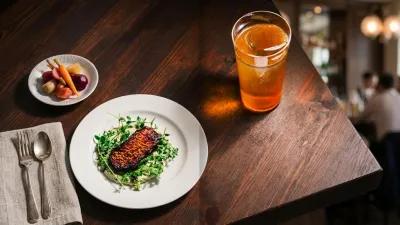
Our third stop was Červený jelen, where we moved straight from cocktail mixology to gastronomy. This time, the vodka wasn’t mixed with other ingredients, but served on its own as an accompaniment to the food — specifically, with the warm ‘Hubert’ starter platter. It features smoked pulled beef in Špork barbecue sauce with caramelised onions, mini chorizo with garlic, crispy spiced pork belly, a sweet-and-sour plum dip and grilled bread.
It is precisely this combination of flavours that offers an interesting canvas for chilled vodka. The pronounced smoky and meaty notes, the fat from the pork belly, the spiciness of the chorizo and the sweet-and-sour character of the plum dip create a fairly intense overall flavour profile. A clean and delicate vodka acts as a contrasting element within this combination. The chilled spirit has a refreshing effect, helping to cleanse the palate between mouthfuls, and its relative subtlety means it does not compete with the bold ingredients on the platter. At the same time, its subtle cereal notes pair naturally with grilled bread and meaty flavours. It is therefore not merely a matter of tradition, where a shot is automatically served with meat specialities; it is a carefully considered combination of textures, temperatures and flavours that makes sense from a gastronomic perspective too.
Three establishments, three different approaches and one common ingredient. At the Hemingway Bar, Elit forms the basis for an elegant cocktail interpretation of luxury; at Forbina, it becomes part of a technically sophisticated and story-inspired composition; and at Červený jelen, it takes centre stage alongside the food itself. This is precisely what makes it so interesting: high-quality vodka need not be merely an unobtrusive accompaniment in gastronomy. When handled correctly, it can play a role of its own — whether behind the bar or right at the dining table.