
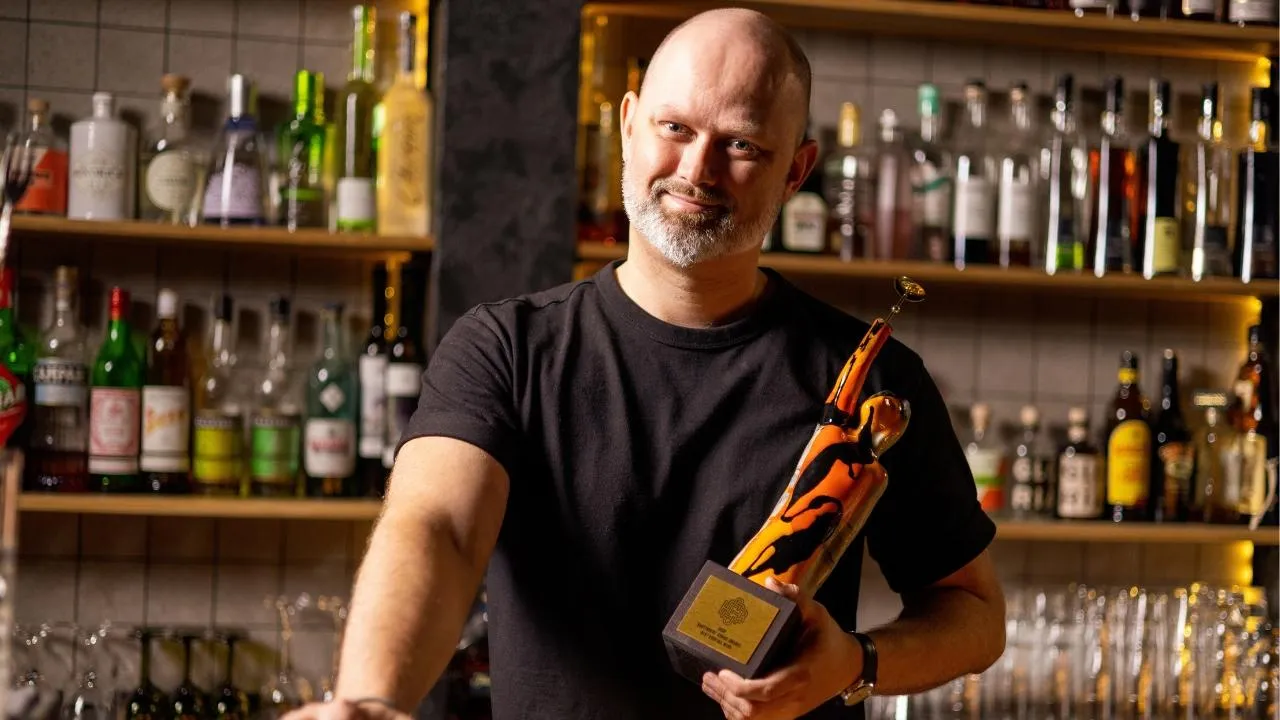

It’s very easy to overlook from the street. Inside, however, lies one of the most interesting cocktail bars on Prague’s current cocktail scene. Tomáš Melzer’s Taigen is built on understated elegance, minimalist presentation, and drinks that, at first glance, don’t try to be anything they’re not. In terms of flavour, however, they manage to surprise with their depth, texture, and wealth of detail. This year, Melzer won the Best Cocktail Menu – Czechia award at the Bartenders’ Choice Awards Central & Eastern Europe for his menu.
“We’re not a speakeasy; we’re just not very visible,” says Tomáš Melzer with a smile. And he’s right. Taigen, on Budečská Street in Vinohrady, doesn’t particularly draw attention to itself from the outside. No grand entrance, no need to convince passers-by that something extraordinary is happening right here. Perhaps that is precisely why taking that first step inside works so well. The same aesthetic continues inside: nothing is superfluous, nothing is garish; everything feels natural, well thought out, and effortlessly elegant. Minimalism is, after all, one of the most accurate words to describe Melzer’s approach. It applies to the space, the glassware, the service, and the way the cocktails are served. But then comes the first sip, and it becomes clear that minimalism at Taigen certainly does not mean simplicity.
Quite the opposite. The flavours are rich, the textures carefully considered, and every detail serves a purpose. With the drinks, you can often sense that a great deal of work went into their final form. At other times, the approach is exactly the opposite: you take a few commonly available ingredients and, rather than resorting to complex techniques, seek out the best possible combination. The result is a cocktail that doesn’t come across as a display of the bartender’s ego. After all, Melzer puts it simply: “I don’t make drinks for myself, but for the guests.” Perhaps that is one of the reasons why Taigen works. There’s no need to hide behind sophistication to show off how skilled the barman is. What matters is what the customer ultimately gets served.
The Mediterranean in a glass, gooseberries after seven months
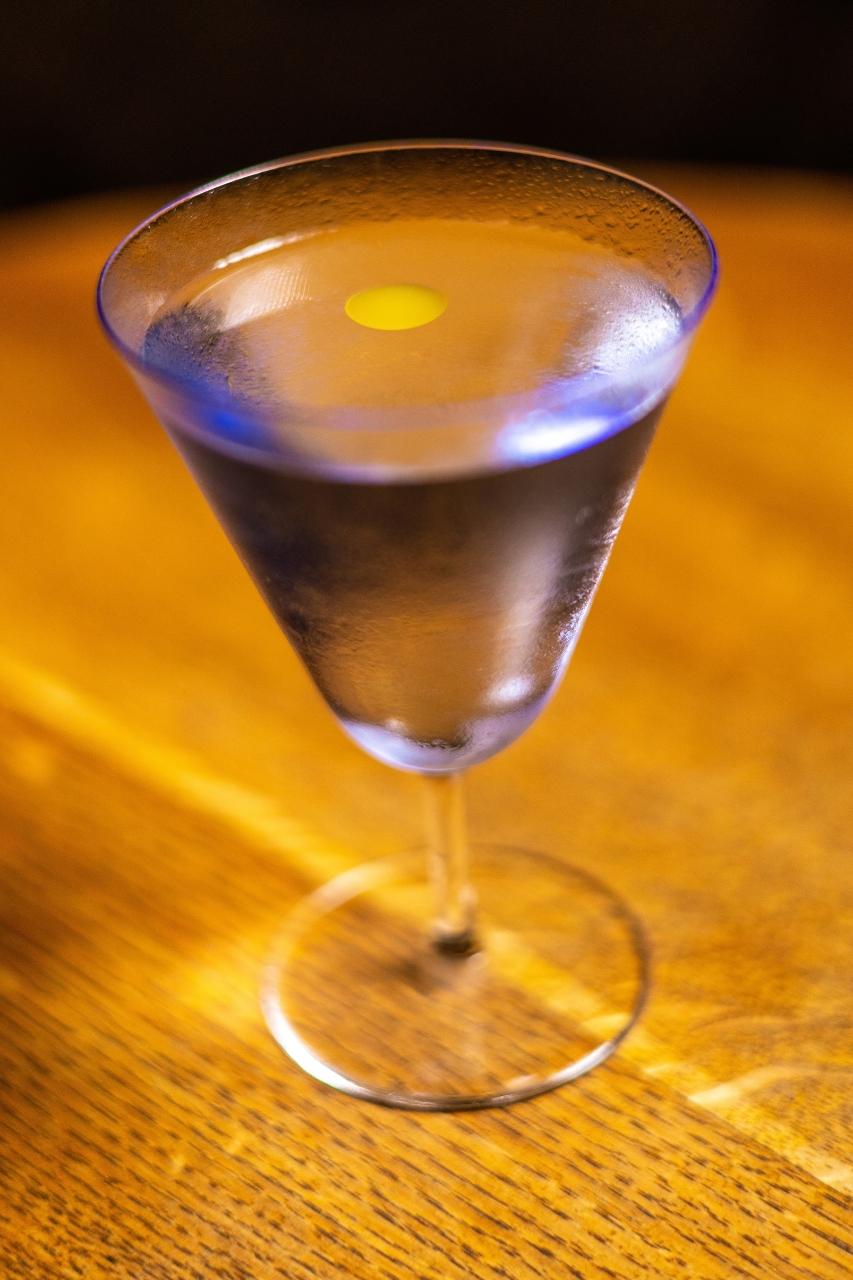
One of the best examples is El Azul. With this drink, Melzer takes the guest on a journey through the Mediterranean: it begins in Spain, continues through the south of France, briefly touches on Italy, and ends in Greece. The base is Gin Mare, a Spanish gin infused with olive oil and lemon, complemented by a dash of French Dolin Blanc vermouth and lemon cordial. This enhances the citrus notes and adds the necessary acidity. Finally, a few splashes of ouzo are added, which Melzer brought back from his holiday in Greece this year. The result is a drink that offers freshness, saltiness, and herbaceous notes, with a slightly aniseed finish, while remaining exceptionally well balanced. It is precisely the sort of cocktail in which the individual ingredients do not overpower one another, but reveal themselves gradually. What’s more, El Azul is simply outstanding.
Fig and Apples represents a completely different philosophy. “It’s one of those drinks where I don’t have to prepare anything and which I really enjoy,” says Melzer. Citadelle non-alcoholic or Chopin Rye Organic is complemented by apple cordial and Three Cents fig soda. It’s a drink that can be made at home without any fancy equipment, and what’s more, it comes in both alcoholic and non-alcoholic versions. It’s lighter, fruity, approachable, and proves that a good cocktail doesn’t necessarily have to be built around an ingredient you won’t find anywhere else. What matters more is how the individual components work together.
Then, however, comes the Golden Cardinal, and here we certainly can’t talk about simple preparation. Gooseberries are left to steep in gin for six to seven months, much like sloe gin is made. It is this time that gives it its depth and character. This is followed by an almost austere combination of three ingredients: gooseberry gin, French Suze bitters, and Ambrato vermouth. On paper, a minimum of ingredients; in the glass, however, a layered cocktail whose character rests on an ingredient that has been given plenty of time. Melzer also points out that drinks like this have their own natural life cycle. When the gooseberry gin sold out last year, the ‘Kardinál’ disappeared from the menu. It has returned this year thanks to stock from last year’s harvest. Next year, however, it may not return. “The gooseberries didn’t grow very well this year,” explains Melzer. And this is precisely where it becomes clear that seasonality at Taigen isn’t just a marketing term, but a genuine part of how they work.
Wax, honey, propolis. And The Karate Kid
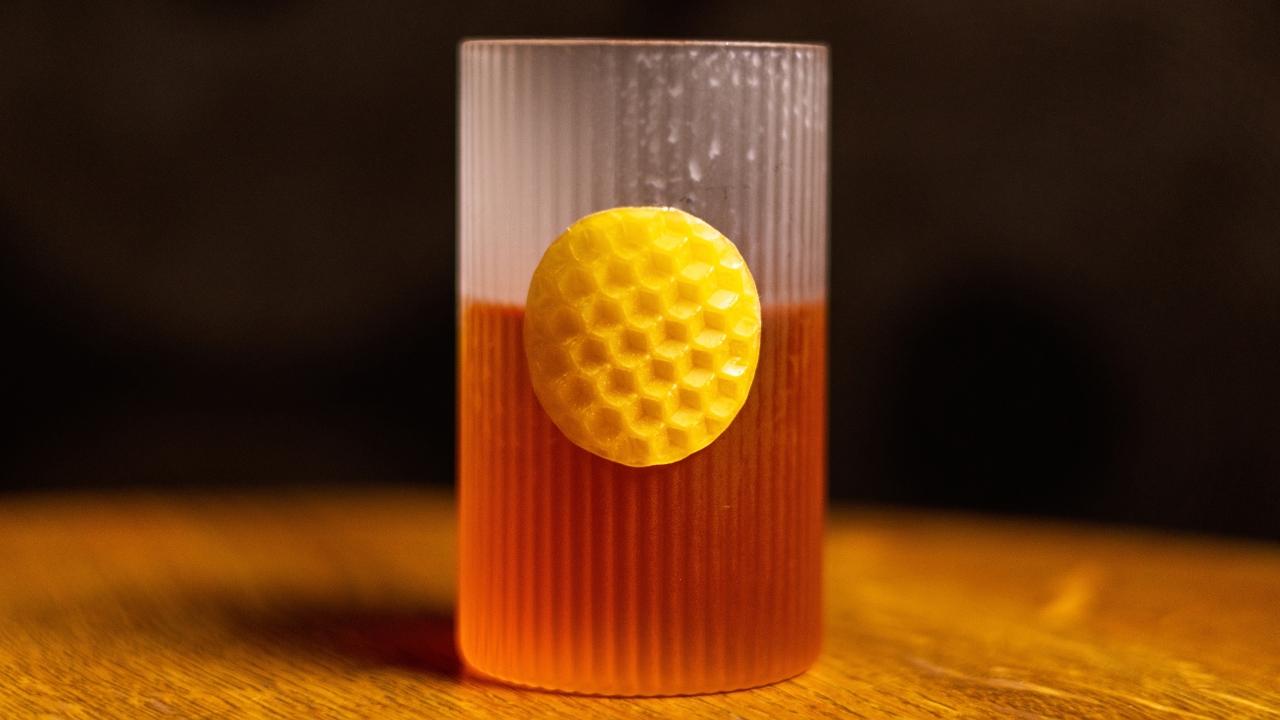
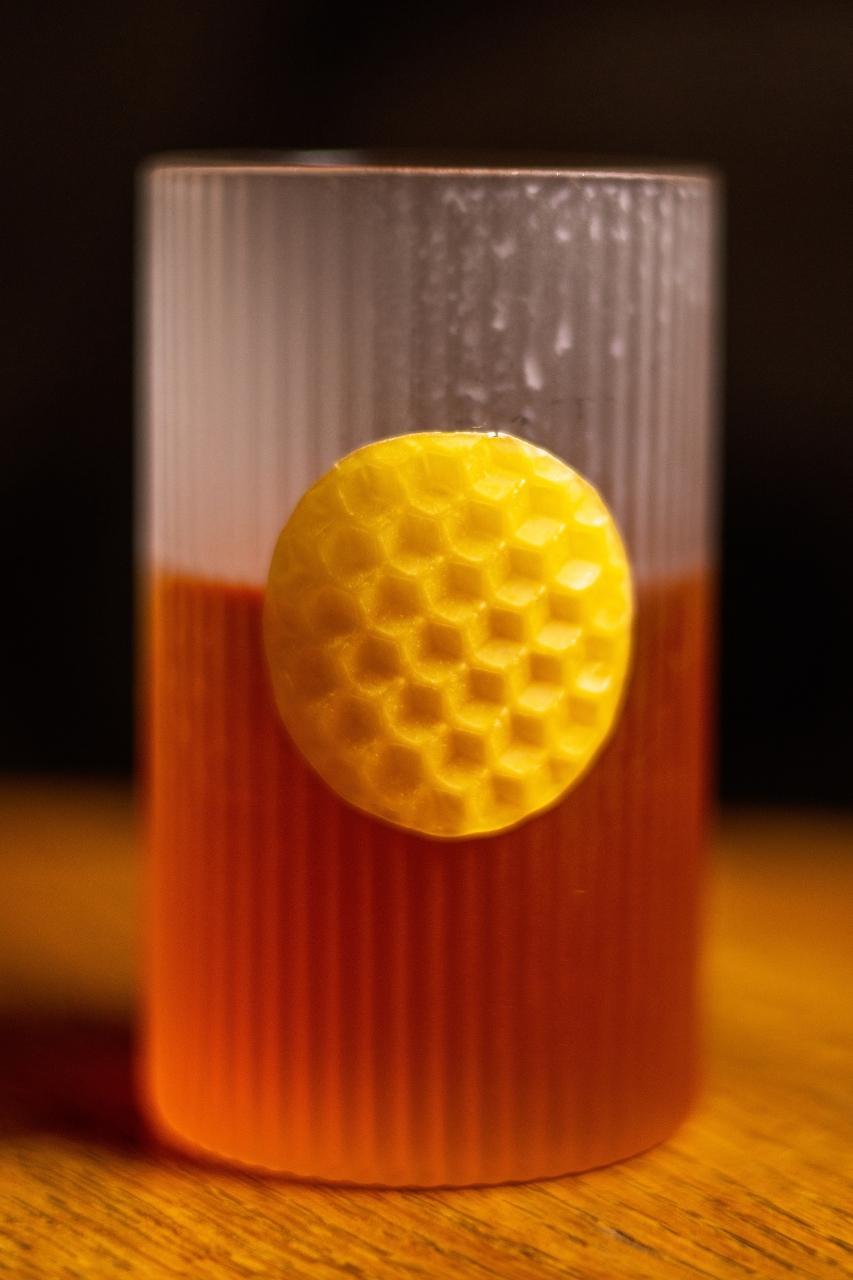
Melzer’s connection to his own ingredients is most clearly reflected in the new creation, ‘Wax On’. The bartender looks after his own beehives and has incorporated practically everything he obtains from his bees into the drink: honey, wax, and propolis. The base is a seven-year-old Havana rum infused with beeswax and honey. The glass is sprayed with propolis before serving, and the resulting drink is finished with a cordial. Moreover, the seemingly simple name conceals three meanings. Wax is the key ingredient in the infusion, a wax decoration adorns the glass itself, and the full name references the famous “wax on, wax off” line from The Karate Kid.
Yet this is not merely a matter of a catchy story. When Melzer extracts the honey, the so-called “caps” are removed from the honeycombs — a thin layer of wax with which the bees seal the cells filled with honey. This mixture of wax and honey would otherwise end up as waste, but at Taigen it is put to further use. Melzer infuses it in rum and then prepares it using the sous-vide method. After freezing and straining, the result is an infused rum that retains both the sweetness of the honey and the characteristic aroma of the wax. During the spring cleaning of the frames, propolis is collected, which becomes another ingredient in the cocktail. It is precisely this sort of detail that explains why the drinks may look minimalist, but their journey to the glass is anything but simple.
French Laundry is similarly intriguing. The name refers to Thomas Keller’s famous Californian restaurant, but also to Melzer’s admiration for the modern interpretation of classic French cuisine and the figures who have emerged from it, such as Grant Achatz. “I like the name and the concept, where they draw on French cuisine but give it a modern twist,” he explains. He tries to bring the same principle into the glass. Calvados, Dubonnet, Dolin Bitter, and Crème de Cassis are commonly available French products; the glass is finished off with a splash of absinthe, creating a variation on the Manhattan. Thanks to the Calvados and blackcurrant, the traditional cocktail takes on a distinctly fruitier character and gains a different flair. Adding to this are Melzer’s own sour cherries, which he pickled last year.
The fact that the menu changes is just as natural at Taigen as working with seasonal ingredients. Around ten drinks have disappeared from the new menu, while ‘Leave Me’ has remained on the menu since the bar opened and nothing about it will change. ‘Freida’ has now made it onto its third menu, although Melzer admits that he’d like to swap this cocktail out too. In contrast, ‘Šaman’ operates outside the standard offering and can change practically every week, sometimes even every day. It is a category created for ingredients that Taigen harvests itself and of which there isn’t enough to warrant a permanent place on the menu. “Theoretically, it could be different every day,” says Melzer. The menu is therefore not a static list of recipes, but a living organism that responds to what the garden, the harvest, their own stocks, or the bartender’s imagination have to offer at any given time.
A drink as a story that doesn’t have to shout
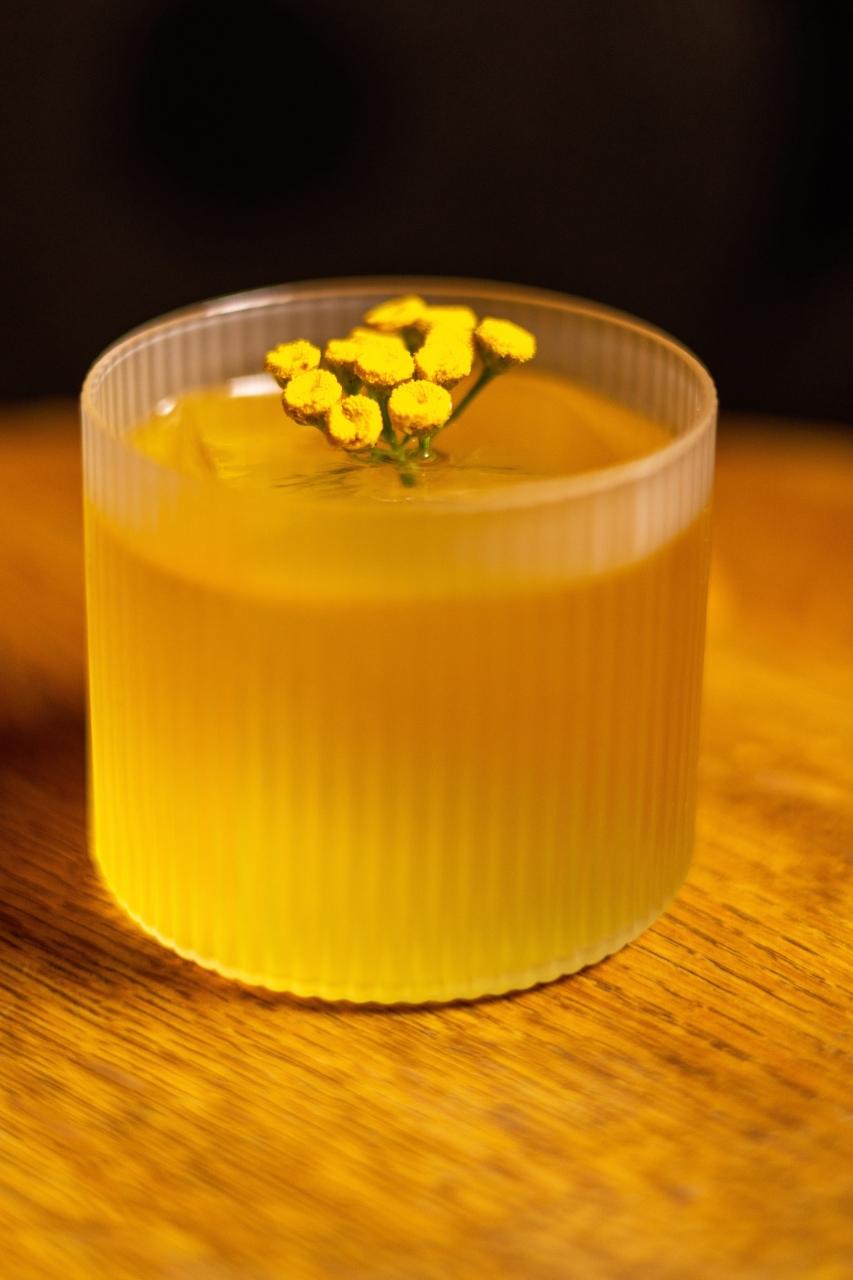
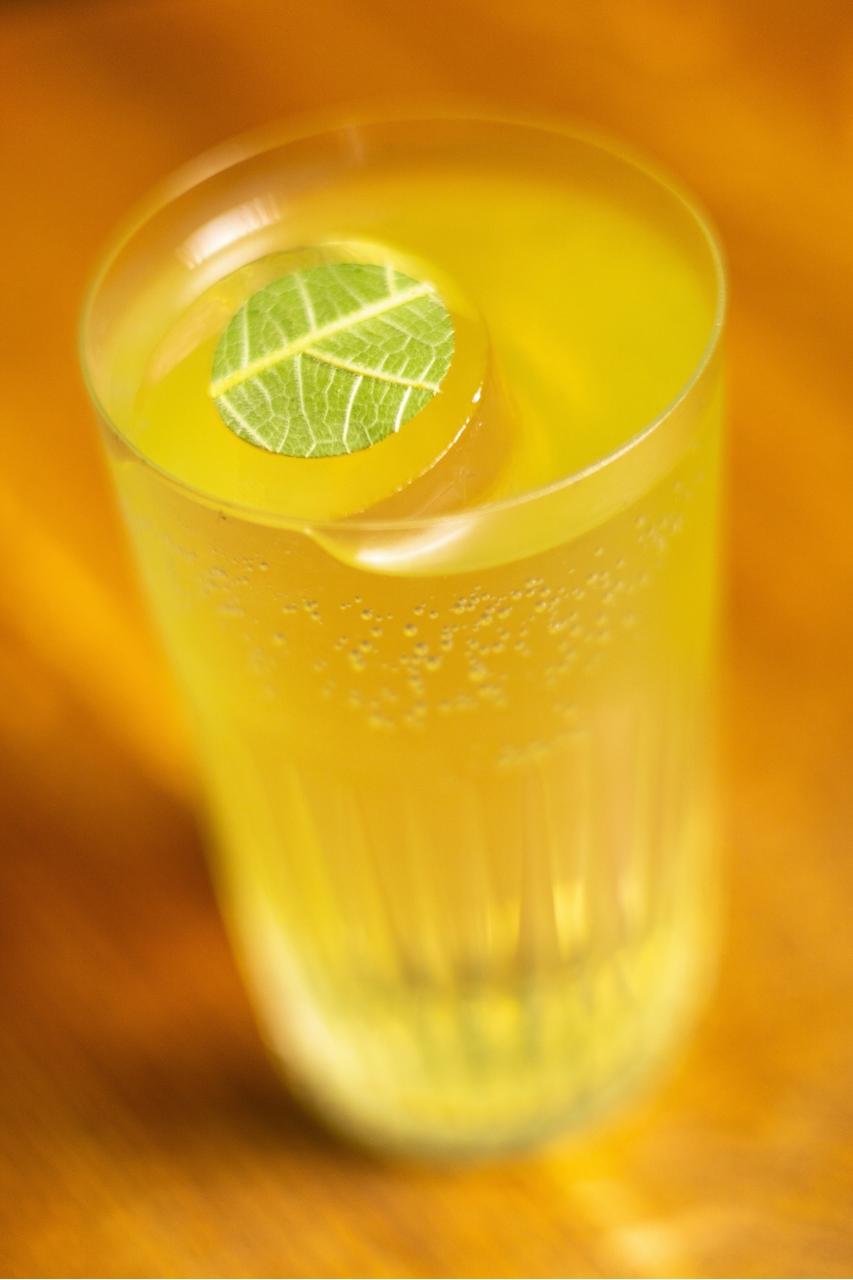
Melzer’s signature style didn’t emerge overnight. From the outset, Taigen has had a subtle Japanese influence, which in the past was also reflected in the names and concepts of individual cocktails. ‘Komorebi’, for example, refers to light filtering through the leaves of trees. The drink was linked to the first collaboration on glassware, each piece featuring its own embossed pattern reminiscent of the veining of a leaf. The cocktail’s yellow colour was intended to evoke autumnal light, and the entire collection was named Haito, meaning the sound of leaves. As the season changed, so did Melzer’s drink. Instead of cognac with chamomile, he used gin, added birch leaves and Gyokuro from the first spring harvest, creating Shinrin-yoku, the Japanese ritual of forest bathing, which aims to clear one’s mind amidst tranquillity and greenery.
Yet the new menu no longer features a drink with a distinctly Japanese name. However, Japanese inspiration has not disappeared from Taigen. It is present in the discipline, the visual calm, the attention to detail, and the way in which individual ideas are translated into their final form. And it is perhaps in this that the bar’s greatest strength lies. Taigen does not seek to dazzle the guest at first glance. It invites them to come closer, take a seat, order, and taste. Only then does it gradually reveal everything that has gone into that seemingly simple glass.
This year, that work has also earned significant external recognition. At the inaugural Bartenders’ Choice Awards Central & Eastern Europe, Taigen won the Best Cocktail Menu – Czechia award, as judged by professionals from the bar industry. For Melzer’s bar, this is a significant accolade, but also one that fits perfectly with the establishment’s philosophy. Taigen does not rely on ostentation. Just like its founder, it doesn’t need to explain why it’s exceptional. You simply have to taste it.
And perhaps that is precisely why Melzer’s statement that Taigen is “invisible” rings so true. From the street, it might go almost unnoticed. Inside, however, you’ll find a bar that understands minimalism so well that it doesn’t need to use it as decoration. At Taigen, it’s a way of thinking: about the space, the ingredients, time, and flavour. And when the barman places a glass in front of you that, at first glance, seems to say almost nothing, you’ll discover that it has a story to tell.