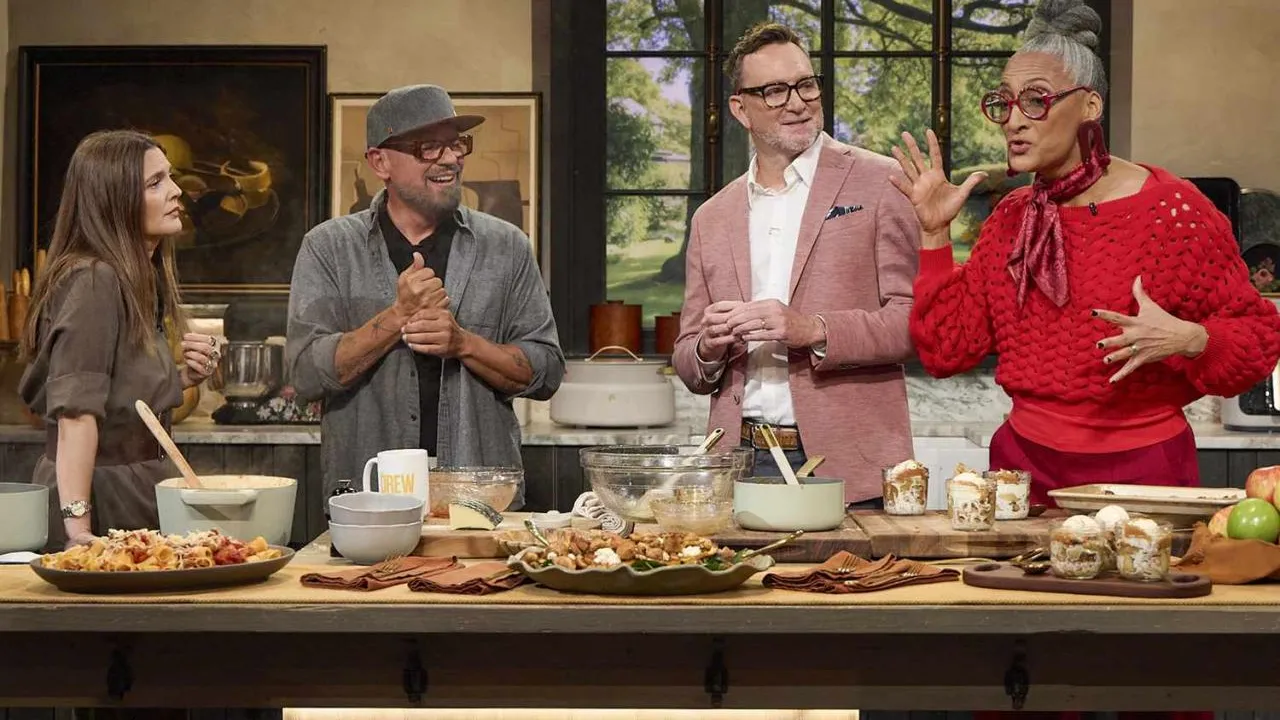

Do you remember them? At first glance, it was just another TV show about food: colourful studios, quick recipes, Hollywood guests, and chefs who moved in front of the camera with the ease of pop stars. When the American broadcaster ABC launched the culinary talk show The Chew in 2011, it seemed to have found the ideal format for an era in which gastronomy had become part of mainstream pop culture. Cooking was no longer just a craft—it was a show. But…
A few years later, The Chew became a symbol of something else: the unraveling of the media image of the famous chef and the exposure of problems that had long existed behind the scenes in restaurants.
The programme had a simple concept: a mix of cooking, interviews, lifestyle segments, and light-hearted humour. Chefs Michael Symon and Carla Hall, along with media personality Clinton Kelly, appeared side by side, but the biggest star was undoubtedly Mario Batali. In his orange Crocs, with his ponytail and energetic demeanor, he became one of the most recognisable symbols of American culinary television. He was a restaurateur, a bestselling author, and the man who helped transform chefs into media celebrities.
Yet it was Batali’s downfall that later shook not only the programme, but the entire image of modern gastronomy.
The scandal that changed gastronomy
The turning point came in December 2017, when the website Eater published an investigative article based on the testimonies of four women who accused Batali of sexual harassment and inappropriate behaviour. Three of them worked in his restaurants and described incidents that, according to them, took place over a period of more than twenty years.
According to their accounts, this involved inappropriate touching, sexual innuendo, and physical incidents in the workplace. Some women stated that they were afraid to speak out because Batali was one of the most influential figures in the industry.
Batali responded with a public apology. He admitted that “much of the behaviour described is consistent with how he behaved in the past” and took responsibility for it.
The reaction from the media and the business world was immediate. ABC initially asked Batali to step down from the programme, and following an internal review of the allegations, it terminated its working relationship with him permanently.
The fallout quickly spread beyond the television studio. Batali announced that he was stepping back from the day-to-day management of his restaurant empire, and his business partners began to gradually end their partnerships with him.
A problem bigger than one chef
What followed revealed a deeper problem than a scandal involving a single media personality. Investigative reports began to expose a culture that had long prevailed in some restaurants. Former employees of Batali’s establishments described an environment they termed a “boys’ club”—a world of powerful restaurateurs, late-night parties, and hierarchical relationships in which it was difficult to speak openly about inappropriate behaviour.
According to staff accounts, complaints were often ignored because people feared professional repercussions. In an industry where reputation and personal connections determine careers, a conflict with an influential head chef could mean the end of job opportunities.
These testimonies fit into the broader context of the then-growing #MeToo movement, which had begun to expose similar cases across many sectors—from the film industry to the media. The restaurant industry, which had long operated on the basis of strict kitchen hierarchies and strong-willed head chefs, suddenly found itself in the spotlight.
Meanwhile, The Chew tried to carry on without its biggest star. However, the loss of Batali was not only a personnel issue but also a symbolic one. From its inception, the programme had been closely associated with his personality—and his downfall changed the way viewers perceived the show. Viewing figures began to fall, and in 2018, ABC announced that the programme would end after seven seasons.
The fall of a celebrity chef icon
Officially, it was a programming decision. However, media analyses often raised the question of whether The Chew would have survived if Batali’s scandal had never erupted.
Just a few years earlier, his career had been regarded as one of the greatest successes of modern gastronomy. Batali co-founded restaurants such as Babbo and Del Posto, helped popularise Italian cuisine in America, and became one of the first chefs to successfully merge restaurants, television, and the gastronomic business into a single powerful brand.
After the scandal, however, his public career practically ground to a halt. He gradually sold his shares in the restaurants, and his name disappeared from most of the projects with which it had been associated.
The story of The Chew thus seems almost symbolic today. The programme was created at a time when chefs were becoming rock stars and television gastronomy was experiencing its golden age. It ended just as the public began to ask what stories lay behind the glamour of restaurants and television studios.
Gastronomy has always been a tough environment. Kitchens run on discipline, pressure, and strong personalities. For decades, these very qualities were often mistaken for charisma and authority. However, the downfall of one of the most famous TV chefs has shown that there is a line between creative energy and the abuse of power—a line that society is no longer willing to overlook.
Perhaps that is precisely why the story of The Chew today feels like more than just an episode in the history of television gastronomy. It is, instead, a reminder of the moment when the culinary world first had to take a hard look at itself—and admit that behind the image of media success there can sometimes lie a culture in need of change.