It begins with an elegant French sparkling wine, followed by stale bread. And in between: tomatoes, yoghurt, duck, cherries, fish, rabbit or apricots – ingredients that often take on surprising forms in the new tasting menu at Jan Horák’s Prague restaurant, Reason. Chef Jan Horák’s cuisine plays with fermentation, full utilisation of ingredients and contrasts in flavour, while the wine pairings take guests on a journey from Champagne through the Wachau, Priorat and Burgundy to a twenty-five-year-old Tokaj. The result is a menu built more on unexpected combinations than on a showy list of ingredients.
From sprat bellies to stale bread
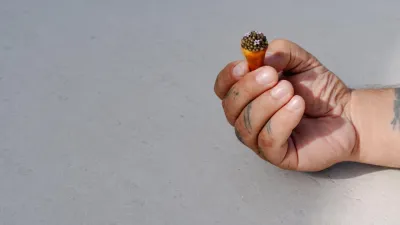
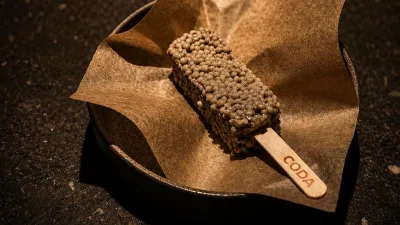
Reason is not the sort of restaurant that needs to win over guests with grand gestures. The very first mouthfuls of our dinner suggest that, here, it will be important to look at ingredients in a slightly different light. The tasting begins with a series of amuse-bouches: a crackling biscuit, cherry jelly and a little cup resembling a beer cone, containing a tartare of fatty sturgeon belly, horseradish-flavoured sour cream and Oscietra Five Star Antonius caviar. What’s more, the fish isn’t used here merely for its flesh – a few drops of sturgeon garum lend the final mouthful a more pronounced fish character.
After the amuse-bouche comes bread and butter, but even here it is not the usual interlude before the main menu. Farmhouse butter from Struh is complemented by fermented garlic with honey, lovage oil, bee pollen, and gooseberry and elderflower cordial jellies. The in-house bakery provides a small loaf, an onion Danish, a beer roll and a potato focaccia with crackling. It’s a small demonstration of the way Reason works: everyday ingredients don’t become mere backdrops, but rather the building blocks for further layers of flavour.
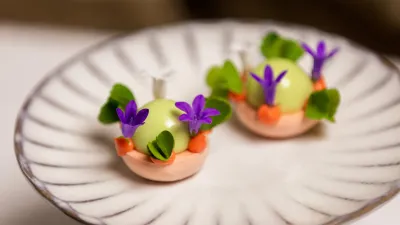
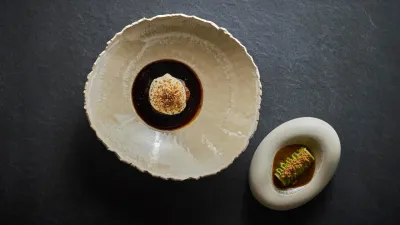
The first main course, Yoghurt & Tomato, is, by contrast, almost a demonstration of purity. The yoghurt semifreddo is complemented by several forms of tomato – its flesh, water, whey and a gel made from green tomatoes. Rhubarb sumac adds tartness and crunch, while olive oil ties everything together. The wine pairing here highlights one of the evening’s strongest points: the 2023 Sauvignon Silex from Domaine Didier Dagueneau is distinctly mineral, and its flinty character pairs naturally with both the tomato water and the rhubarb.
Next comes the kranas, this time as the main ingredient. The fish’s back is marinated in a koshu made from redcurrants and jalapeños, while the tartare returns at the base, accompanied by oil from redcurrant twigs and a light sauce made from watermelon, dashi and kombu. Horák does not simply present the fish “prettily”, but works with it across a range of techniques, allowing it to encounter acidity, umami, spiciness and sweetness. This is accompanied by a 2024 Grüner Veltliner Federspiel “Grabenwerk” from the Wachau, which keeps pace with the dish’s freshness.
Then comes one of the evening’s most striking moments: duck, cherries and beetroot. The duck breast is complemented by beetroot, crackling, smoked and grilled cherries, and a sauce made from duck carcasses, blended with the pan juices and duck fat. It is a dish brimming with smokiness, sweetness, acidity, fat and a pronounced meaty flavour. The duck thus pairs naturally with Ruinart Rosé Brut Champagne, which offers red fruit, creaminess and a light hint of brioche.
But an even bigger surprise follows shortly afterwards. Traditionally, the cavatelli at Reason are no longer made from ordinary flour, but from stale bread. The sauce is based on a three-month-old bread base, baked yeast, butter, Marmite and fermented bread syrup. Finally, Belper Knolle makes an appearance – a distinctive Swiss cheese coated in pepper. “Umami on umami with umami,” says head chef Jan Horák as the dish is served – and it would be hard to find a more accurate description. The dish is both playful and highly focused, demonstrating why cavatelli are one of Reason’s signature dishes.
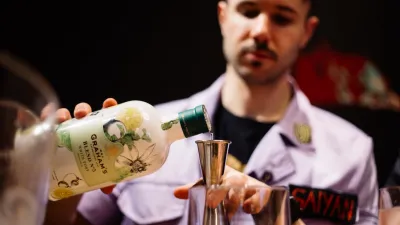
Moreover, the bread theme continues at the bar: it forms the basis of the Bread Martini, made with bread cordial, caraway and vermouth. Even the crumbs of Belper Knolle that can no longer be used in the usual way are infused in vodka. “Zero waste” is not just a slogan here, but a practical part of working with ingredients.
Pairing is the second kitchen
After the intense cavatelli, the evening takes a breather. A Domaine Paul Prieur Sancerre Blanc 2023 accompanies the mackerel, which has been resting in the fridge for several days to firm up the flesh and make its fat easier to work with. The fish is lightly seared; the trimmings are transformed into rillettes with crème fraîche and apricot umeboshi, and a fresh apricot with apricot gel is served alongside. The sauce is based on the ajo blanco technique, but uses fresh almond milk and oysters instead of bread. The Sancerre is distinctly mineral, juicy and citrusy – exactly the sort of wine that can cleanse the palate after such a rich and layered dish without overpowering it.
Next comes the rabbit, and with it another distinct hallmark of Horák’s cuisine. The whole rabbit is deboned; the thigh is turned into a stuffing and returned to the centre of the meat. The dish is served cold, which allows the herbs, acidity and texture to shine through. It is accompanied by a herb salsa, pickled gooseberries, a brioche brushed with rabbit drippings, and a rich rabbit jus. This is accompanied by a 2023 Gevrey-Chambertin from Domaine Jean-Marc Millot – a Pinot Noir that naturally continues the meat-focused part of the tasting.
Here, wine is not merely a list of prestigious bottles. The pairings have their own narrative and shift in pace throughout the evening – from Champagne through mineral Sauvignon and Veltlín to Burgundy. Each bottle takes the meal in a different direction. Non-alcoholic pairings follow a path of their own: strawberry cordial with thyme and verjuice, tomato water with yoghurt and rhubarb, cherry cordial with pepper, or a non-alcoholic version of an Amaretto Sour. It doesn’t feel like a compromise, but rather a language in its own right.
After the rabbit, the menu begins to shift towards the sweet section, overseen by the talented Anežka Popková. Here, too, there’s no slipping into a simple “dessert” mode. Strawberries & Tomatoes combines strawberry chirashi, strawberries from the Vraňany farm, fermented tomatoes, strawberry espuma and a granita made from tomato water with shiso. Strawberries thus become more than just a sweet ingredient – their character blends with the fermentation and the freshness of the tomatoes.
And then comes the apricot with ricotta. The dessert draws inspiration from Grandma’s apricot cake, but rather than a nostalgic replica, it becomes a modern composition: apricot sorbet, a brown-butter madeleine brushed with spruce shoot honey, ricotta cream, apricot compote and homemade apricot kombucha. To accompany this, we open a bottle of Domaine Bott-Geyl Muscat d’Alsace 2019, which guides the dessert in an aromatic direction while allowing the apricot to shine through.
The very end is reserved for courgette and gooseberries. The courgette is served grilled and paired with Amalfi citrus oil, verbena and vanilla namelaka. The gooseberries feature in a sorbet with lemongrass, accompanied by coffee-infused vanilla cream and a citrus “broth”. The wine, however, takes us in a completely different direction: the 1999 Ostrožovič Tokajské Samorodné Sladké has aged for over a quarter of a century and offers mature honeyed and fruity notes. It is a finale built on the contrast between the wine’s age and the tartness of the gooseberries, vanilla and citrus. The desserts are highly original and of the highest quality.
Cheese comes at the end. And with it, Barolo
Anyone expecting the final note to be sweetness will be disappointed at Reason. The tasting may conclude with yet another detour – this time to cheeses and wine. G.D. Vajra Barolo Ravera 2020 is served, accompanied by a selection of four cheeses from northern Italy and Lombardy. One is washed in beer and matured in crushed hops; another is made from buffalo milk and has black mould; yet another is matured in fig leaves; and the finale is a blue cheese washed in rum and wrapped in cocoa beans.
And this is where the whole evening comes full circle. From the outset, Reason has straddled the line between tradition and experimentation: stale bread is transformed into pasta, cheese scraps into an infusion, a tomato into several different textures, redcurrants into koshu, and rabbit into a cold, herb-infused main course. The wine follows the same logic. It’s not just about pouring something good to accompany the meal, but about uncovering another layer of its story.
This is precisely what makes the current Reason so fascinating. In Horák’s view, good fine dining doesn’t need to overcomplicate ingredients to be sophisticated. It’s enough to take them seriously, utilise them down to the last meaningful detail, and give them plenty of space. Jan Horák thus crafts a menu that is at times surprising, at times playful, but above all consistent: almost everything that arrives at the table has a reason for being there. And that is precisely why the name “Reason” makes sense.